PO Box 3413
Wellington 6015
New Zealand
July 2008
Dear Friends,
In 2007 someone wanted an email interview, and sent the following questions. I saved the questions, answered them, and then discovered that I had lost the original email. Efforts to find the interviewer have failed, so I am putting this on my website with the hope that it will connect with the right person or persons.
INTERVIEW BEGINS:
Q: What's the best and worst thing about being a writer?
A: The best thing about writing for children is the response from readers. Children are so generous with their feedback- and also very honest. The worst thing is the adult expectation that a writer is also a speaker. Most writers struggle with speaking in public. Margaret Mahy is the only writer I know who does both superbly and with ease.
Q: What has surprised you the most about being a published author?
A: The change in people's perception. People I had known for years became a little nervous. Perhaps they thought I would put them in a novel. I also gained many new acquaintances who were interested in writers but not necessarily Joy Cowley. Now when children ask me what it is like to be famous, I quickly explain that the so-called fame is simply advertising. Writers, like singers and actors, are advertised by name. If I made violins or cakes, no one would know who I was
Q: I believe you've been running writing workshops for people whose culture is not adequately represented in their children's books. What motivates you to do this and how has it been going?
A: At 70, I have now retired from these workshops, but I did them for about 20 years in Singapore, Malaysia, Brunei, South Africa, Iceland, Hong Kong, for Polynesian and Asian people in New Zealand and on Native American Reservations. When I was a child all of my reading material came from the UK or the United States. I thought there was something inferior about being a New Zealander. I believe it is very important that children see themselves in their books. My main focus has been early reading books. I edit the stories to the appropriate levels, design layout and notes for illustrators and help with production. This means that children get an effective early reading text written and illustrated by their own people, especially for them
Q: Which book written by yourself is your personal favourite and why?
A: The most recent book is always the favourite. But I am not very faithful to my books. As soon as a new idea comes along, I forget the other. There are some books that I still like: The Silent One, Bow Down Shadrach, The Wild West books, Hunter, some of the picture books, but there are others that I'd like to make disappear.
Q: You have written more than 600 early reading titles! That's an unimaginable number for many people. Where do you find ideas for your stories?
A: As long as I'm working with children, there will be ideas for stories, but I guess they will run out one day. While, I've written hundreds of titles, this has been over a space of forty years.
Q: Have you ever had the dreaded writer's block? If so, how do you overcome it?
A: For me, writers block is simply flat batteries. I believe that creative work needs to come from peak energy and for me that time is early morning. I protect my writing time by going to bed early about 8.30pm. If I find that my writing is winding down it is because I am winding down. I take two or three days off, get lots of sleep and build up energy again. That always seems to work for me,
Q: Do you have a nickname and if so what is it?
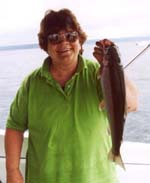
A: My children have always had nicknames for me. When they were little, I was two people: Mrs Woolly and Witchypoo. Mrs Woolly was the nice lady who played with them, told them stories and gave them puddings. Witchypoo was the nasty woman who told them to tidy their rooms, wouldn't let them wear nail polish to school and made them eat vegetables before those puddings. When they were of high school age, my children called me Marzipan. I don't know why. These days my middle-aged kids call me "The Old Trout" and that is a warm, affectionate title.
Q: What is the funniest thing you did in your life?
A: 1) I said "Thank you" to an ATM machine.
2) Sometimes I get into funny situations with my adult children. My daughter Sharon and I went to a modern performance of King Lear at Sky City and forgot where we parked the car. We walked the car park until midnight then got a taxi home, greatly alarming Sharon's husband John who thought we'd had an accident. When he learned the truth he thought we were a couple of twits and couldn't understand why we were helpless with laughter.
Q: Was there someone who encouraged you most in your writing?
A: There have been many people who have helped with time or by example. Monte Holcroft, the editor of the New Zealand Listener, was very patient and kind to an aspiring writer. Always, when he rejected stories, he included an encouraging, handwritten note. The latest in a long line of mentors has to be my stepson Andrew Mason who is a first rate editor. He has edited several award winning books including Michael King's History of New Zealand, is always in demand, yet he finds time to comb out the tangles in some of my longer works.
Q: I believe one of your sons had difficulty learning to read. Did you also have the same problem? When you began writing for him and children with similar difficulties, what style of writing did you take in order to make it easier for children to read?
A: My son Edward had a different set of problems. He is an auditory learner who is good at math, likes to read for information but doesn't relate to fiction. I was a visual learner who needed to read for meaning and who could not make sense of the old phonic system of learning through isolated bits of information. What Edward and I had in common was that the reading system of the day did not meet out needs, and consequently, all we learned from our books was a sense of failure. These days educators are much more aware of the differing learning needs of children and reading schemes cater for children's learning rather than teachers' teaching. While most children are either visual or auditory learners, there is a third group - kinesthetic learners, children who need to be active while learning. Unfortunately, they can be disruptive in class and some are labelled ADHD and sedated. This is a tragedy. I try to cater for all learners in the books I write. For the kinesthetic learner there are books of rhyme and chant that have strong rhythms so that they can move their bodies while they read.
The most important feature of an early reading book is that it be entertaining, a real story with a well-defined plot and a satisfying ending. I've found humour a good ingredient. No child can be tense while he or she is laughing. The stories also need to be affirming of the child. Small is always the winner.
Q: What/who are some of your all-time favourite books and authors?
A: We have some very good children's authors in New Zealand, and classics like Tess Duder's "Night Race to Kawerau," David Hill's "See ya' Simon," William Taylor's "Crash," Sheryl Jordan's, "Rocco" and many new writers whose work will add to the list. Sometimes I think it a shame that our super-star Margaret Mahy has been branded a children's author because so much of her writing is also suitable for adults. Overseas authors? I like David Almond, Philip Pullman, Sharon Creech, Jerry Spinelli, Katherine Paterson, Lois Lowry, JK Rowling, Janeen Brian. The list goes on and on.
Q: In your opinion, what is the hardest part of writing novels in particular? Why?
A: I don't find novels hard. They take a long time to create but they are easier than the early reading books that require so much engineering. It is usual for me to carry a novel in my head for several years before I write it. At quiet moments, I play with it, developing characters and plot, trying different voices, visualizing the setting. It takes ages to flesh out a novel to the stage where it's so real I know it as a memory of something that has happened, rather than an invention. Then I sit down and write. I can get a first draft down in two or three weeks. For the next three months, I go over and over it, attending to the pacing and generally tidying the language. When I've got it as good as I can get it, I send it off.
Q: Now, I understand you live in Wellington, but also have a cottage in the Marlborough Sounds? How do the two places help with the writing of your books?
A: In Wellington and the Sounds, there are always demands on my time so that I don't get much space for creative writing. I usually go away beyond phone, faxes, e-mails and doorbells to put down the ideas that have been inspired by my homeland. I have a favourite writing place in Chautauqua, NY. It is an attic room in an old inn, where I sit watching squirrels run along the branches of enormous trees. Opposite my room is another tall white building, the Carey Inn and I look directly into the room where George Gershwin composed some of his music.
Q: How have your friends, family, and local community reacted to your status as a published author?
A: My family has always lived with it. They are used to a mother who day dreams. I don't know what friends and community think. I suspect that some of my smartly dressed relatives think I'm a bit odd because I'm not much interested in clothes or shopping.
Q: What has been your most memorable fan encounter so far?
A: I had been on the road in the USA for several weeks, talking to teachers, visiting schools, and I was quite homesick. I turned up at this elementary school and although it was usual for a school to be ready for me, this place seemed deserted. There wasn't even the usual buzz of classroom noise. I did wonder if I'd come on the wrong day. I cautiously approached the reception desk, introduced myself and asked if I was expected. The woman at the desk said indeed I was and that she would escort me. This in itself was rather strange. We walked up a long and absolutely silent corridor, rounded a corner and there, in a public area was the entire school lined up, teachers and pupils alike wearing white t shirts with I love Joy Cowley printed on them. But that wasn't all. As I stopped dead in amazement, everyone started singing, Pokare kare ana. Yes, they had a New Zealand teacher at the school. Of course I cried. I bawled right into the zoom lenses of their video cameras. It was all just too much for my home-sick heart,
The funniest fan letter came from a 9 year old California girl, She asked the usual questions: What are the names of your children? Do you have any pets? What is your favourite food? But the last question was the most interesting. She asked, Are you still alive?
Q: Tell us a little bit about Storylines and why you decided to be a patron of Storylines.
A: The Storylines Festival began about 16 years ago with a small suggestion. NZ Children's Writers and Illustrators gathered for a hui at our bay in the Sounds, just over 40 of us, and each of us was supposed to prepare a question or a topic for discussion. Mine was the suggestion that it would be great if we could have a festival of NZ children's literature put on by writers and illustrators for children - and free. Everyone agreed. But although I can have good ideas, I'm not great at follow-through, and the idea might have fallen dead without the enthusiasm of Gaylene Gordon and Tessa Duder. With their organizational skills, the following year the 1st Storylines festival was held at the Auckland museum. We thought that about 2000 people might turn up. There were about 10,000. Since then the festival has grown and is now the biggest celebration of literature for children in the world. There are wonderful sponsors who help us with funding and The Edge gives us the Aotea Centre each year, A Storylines bus takes authors and illustrators to schools in the preceding week, and the family day on the Sunday now attracts around 30,000 people. Storylines is organized by the Children's Literature Foundation of New Zealand who have now added Storylines to their official title. I am a patron along with Margaret Mahy.
Q: What is your key message for all aspiring or yet-unpublished authors?
A: 1) Hang in there! It can be a long apprenticeship but it's worth it. Just remember that we all start in the same place.
2) Write something every day. Writing is like swimming. A coach won't be able to teach you much unless you are in the water and active.
3) It really helps if you are a good reader. You will become a better evaluator of your own work.
4) Share your writing with friends. I think it's important that we do this on the way to publication. Some folk say they just write for themselves but I find that hard to understand. Writing is a form of communication.
5) Write what you know. If the story isn't real to you, it won't be real to the reader.
Q: Ask yourself up to 3 questions that you would have liked interviewers ask you but so far were never asked (and answer them if possible). (This is also a chance for you to highlight things we didn't know about you, e.g. a charity you've setup, etc.)
A: 1) My husband Terry and I take a good income from my writing and we recycle the rest. We see this more as duty than charity and I don't wish to comment except to say I like the words of St Augustine: "He who possesses a surplus, possesses the good of another."
2) Most interviewers shy away from the subject of my spirituality. Perhaps they think it un-cool. I believe that we all have a spiritual aspect to ourselves, and that is the part of me that drives much of my writing. I'm a practicing Catholic, but I'm not talking about religion. I could say that. my religion is the banana skin and spirituality is the banana - container and contents. I read widely from different traditions and an aware of a deep mystery underlying all religions. At that level, writing is for me, inseparable from prayer.
3) If someone asked me how I see myself, I wouldn't hesitate to say," Mother". I think that everything else comes under that wide umbrella. A mother is what I am and writing is what I do.
Love from your friend,
Joy Cowley